Buying & Renovating a House in Italy: What the Listing Photos Don't Tell You
That crumbling stone farmhouse for €85,000 looks like the dream. It might be. But the price of the house is almost never the real number — and the gap between what you pay for the property and what it costs to actually live in it is where most people's plans go sideways.
This page walks through what actually happens after you sign: the permits you'll need, who's legally allowed to do the work, what it really costs, and the tax breaks most buyers never claim. Everything here is sourced from current Italian building law and 2026 market pricing, not secondhand stories.
Italy Doesn't Have One Renovation Permit. It Has Three.
Before you budget a single euro, you need to know which category your project falls into — it determines the cost, the timeline, and who's allowed to sign off on it.
Edilizia libera (free building activity). Cosmetic work — painting, replacing a door, cleaning a facade. No permit required, no cost. The one exception: if your property carries a landscape or heritage restriction (common in historic centers and protected regions), even cosmetic work on the exterior can need sign-off.
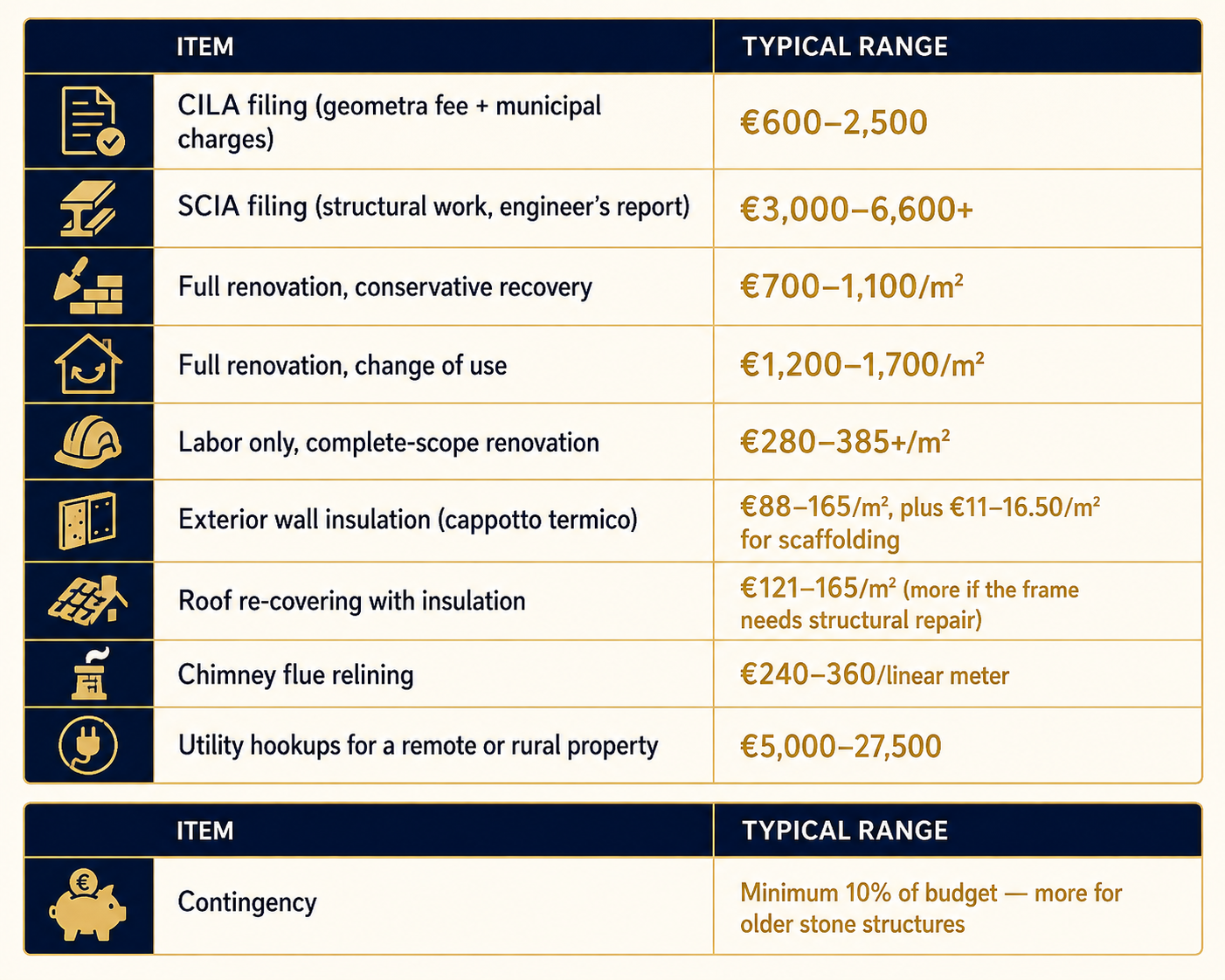
CILA (Comunicazione di Inizio Lavori Asseverata). "Extraordinary maintenance" — a new bathroom, a moved partition wall, anything that doesn't touch a load-bearing wall or the roof structure. A registered technician (geometra, architect, or engineer) files it with a sworn statement, and work can start the same day. Typical all-in cost: €600–2,500.
SCIA (Segnalazione Certificata di Inizio Attività). Structural work — opening a door in a load-bearing wall, reinforcing foundations, touching the roof frame. This requires a structural engineer's report filed with the local Genio Civile office. The municipality has 30 days to review it and can halt work if something's wrong. Typical all-in cost: €3,000–6,600+.
Permesso di Costruire. The heaviest tier — new construction, like an added garage or outbuilding. Administrative review alone typically runs 60–180 days, and if your property sits in a protected landscape area, a separate authorization from the regional Soprintendenza can add another 60–120 days on top of that. A real timeline from submission to shovels-in-ground: six months is normal, not an outlier.
Skip the correct tier and you risk a demolition order — and you forfeit any tax incentive tied to the work.
Who's Actually Allowed to Do the Work
Here's the part that surprises people with real construction experience back home: it doesn't matter. By Italian law, all but the most minor work must be certified by a professional registered in Italy — a geometra, architect, or engineer, depending on the project's complexity. A foreign license or decades of hands-on experience doesn't transfer into this system. Work done outside it generally can't be legalized after the fact, and it puts your ability to sell or insure the property at real risk.
A geometra is the workhorse of this system — a state-registered technical professional who handles land surveying, permit filings, project oversight, and final certification. For most renovation work, and even for a new accessory structure like a garage, a geometra can sign the plans without needing an architect or engineer. Major structural work and new residential construction above certain thresholds are where an architect or engineer becomes mandatory.
Finding one you can trust: ask your real estate agent for a recommendation, but don't stop there. Every geometra must be registered with a provincial Collegio dei Geometri, and the national council maintains a free public registry — the Anagrafe Nazionale — where you can search by name or province and confirm someone is actually licensed before you ever meet them. Local expat groups and forums are worth checking too, and if you're already working with a notaio or a real estate lawyer for the purchase, ask them — they work with geometras constantly.
What It Actually Costs
These are national 2026 averages. Regional and local factors — remoteness, altitude, the specific material a heritage restriction requires — can push these up.
The Tax Incentives Most Buyers Never Claim
Italy offers real deductions for renovation work, though the rates step down each year — verify current figures before you rely on them.
Bonus Ristrutturazioni: 50% for a primary residence (up to €96,000), 36% for a second home, in 2026.
Ecobonus: the same schedule, for energy-efficiency work — insulation, heating systems, and similar.
Sisma Bonus: up to 85% for work that measurably reduces a building's seismic risk class, available in seismic zones 1 through 3 — which, depending on where you're buying, may cover more of Italy than you'd expect. Some regions have been reclassified into higher-risk zones in the past 15 years.
These are deductions spread over ten years on your tax return, not upfront cash — a distinction that catches people off guard. For the fuller picture on filing as a foreign owner, the Complete Italy Tax Guide goes deeper than this page can.
After the Work: Making It Legal to Live In
Once construction wraps up, the building may need its own certificato di agibilità — a habitability certificate, required for new construction or any work affecting safety, sanitation, or energy performance. It's filed as a self-declaration by your professional, and the municipality then has 180 days to inspect. If a property lacks this certificate, it's not necessarily a dealbreaker for a sale, but notaries commonly require a technical compliance report before they'll proceed — and that's a real bottleneck people hit without warning.
One More Thing Nobody Mentions
If the previous owners took the kitchen when they moved out, that's not a parting shot. In Italy, a kitchen is legally treated as furniture, not a fixture — it belongs to whoever bought it, the same as a sofa would. Budget for a new one; it's normal, not a red flag on the sale.
FAQ
-
Not the licensed work. Regardless of your nationality or experience level, structural and most technical renovation work must be certified by a professional registered in Italy — a geometra, architect, or engineer. Purely cosmetic work like painting is the exception; that falls under edilizia libera and needs no permit or license at all.
-
Almost always, yes — the question is which one. Cosmetic work needs nothing. Non-structural changes need a CILA. Anything touching a load-bearing wall or the roof structure needs a SCIA. New construction, like an added garage, needs a full Permesso di Costruire. Skipping the correct tier risks a demolition order.
-
It depends heavily on scope. A conservative, character-preserving renovation runs roughly €700–1,100 per square meter nationally; a full renovation involving a change of use runs €1,200–1,700 per square meter. That's before permits, furnishing, and the contingency fund every renovation needs.
-
A geometra is a state-registered technical professional who handles permit filings, project oversight, and certification for most renovation and small new-construction work in Italy. For the large majority of residential projects, yes — you need one, and their sign-off is what makes the work legal.
-
Yes. Current 2026 incentives include the Bonus Ristrutturazioni (50% for a primary residence), the Ecobonus for energy-efficiency work, and the Sisma Bonus (up to 85%) for seismic-risk-reducing work in qualifying zones. These are multi-year tax deductions, not upfront cash.
Where to Go From Here
If you're still deciding whether a move like this fits your life and budget in the first place, that's exactly what the Italy Retirement Blueprint walks you through.
If you're already past that and into the specifics of a property you're considering, a consultation call is the fastest way to get answers that actually apply to your situation.
And if you haven't picked a place yet, the town quiz matches you to real Italian towns before you fall for a listing photo.