
Italy Visas & Residency: Which Route Fits Your Plans?
You might be retiring, keeping your remote job, joining family, studying, or starting a business. Those are different plans, and Italy has different immigration routes for them.
This guide compares the main Italian visa options and points you toward specialist routes where they apply. Start with your citizenship, how you will support yourself, and what you actually intend to do in Italy.
Before you book the move, find the route that fits the life you want to live.
Start with the free Italy relocation roadmap
By Ori Pas • Last reviewed: 18 September 2026
First: do you need an Italian visa?
Already an Italian citizen? Your starting point is the paperwork for moving and registering your residence, rather than a visa application.
A citizen of another EU country? EU residence rights may allow you to move to Italy to work, study, or retire. Longer stays come with conditions and registration requirements; retirees should check resources and health coverage. Non-EU family members have their own procedures. Check the EU’s official residence guidance.
A non-EU citizen planning a longer move? You will generally need an appropriate long-stay route, unless an exemption or existing residence right applies. An Italian national visa is normally the entry stage for a stay exceeding 90 days; the residence permit is a separate step after arrival. Italian Ministry of Foreign Affairs: entry visas.
Only coming for a shorter visit? Read the short-stay section below. A scouting trip and a move to Italy are different immigration situations.
Compare the main Italian visa routes
Use this as a shortlist, then read the relevant section. Meeting one headline requirement does not mean you qualify for the whole route.
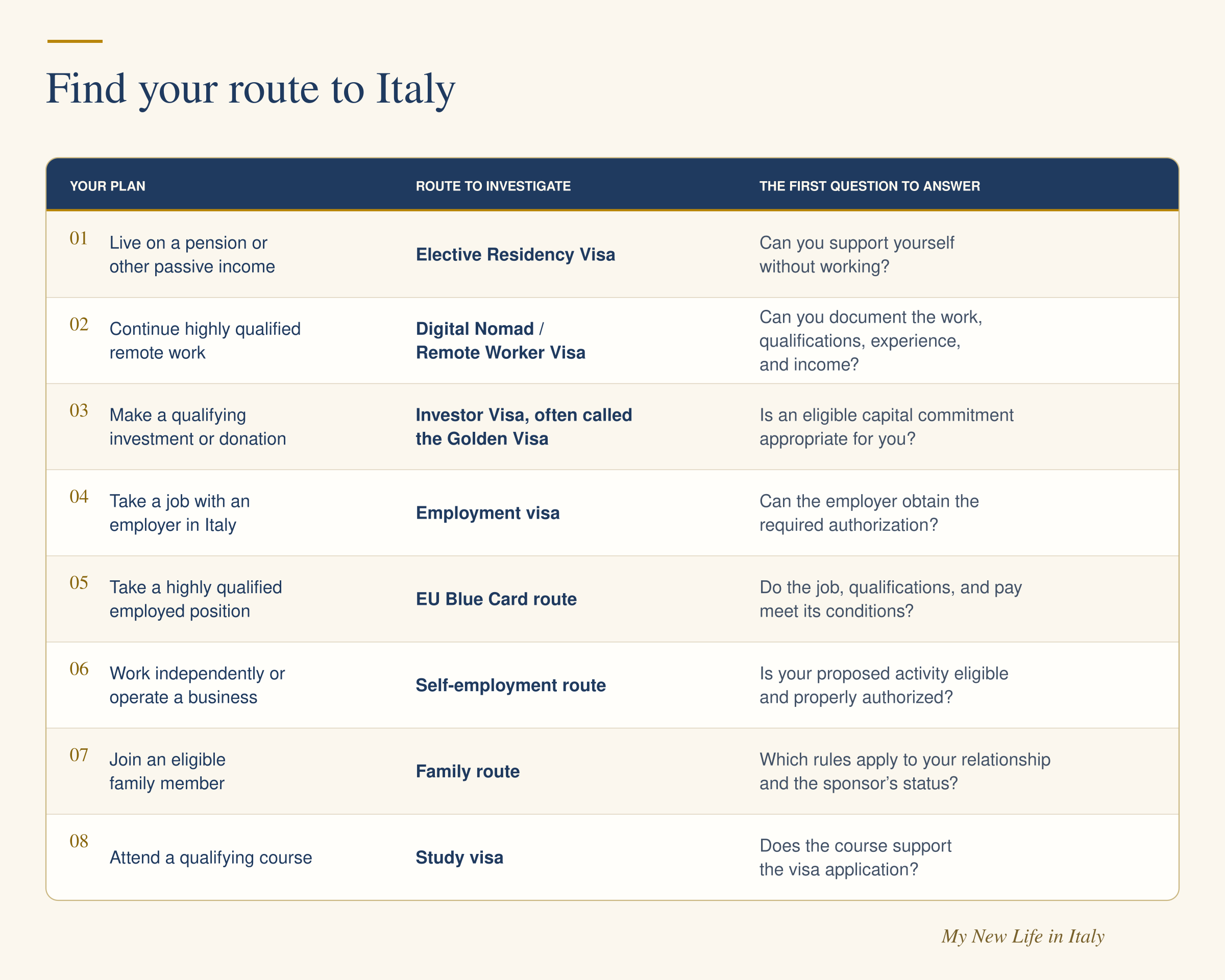
Official route details are linked in each section below.
Elective Residency Visa: living in Italy without working
The Italy Elective Residency Visa is worth exploring if your pension, rental income, investments, or other accepted passive resources can support your life in Italy.
The central restriction is work: this route does not authorize employment or self-employment, including remote work performed from Italy. A plan to retire partly and keep freelancing needs a different assessment.
Expect to document stable financial resources and accommodation. Follow the current checklist from the Italian consulate responsible for where you legally reside. Family requirements and the assessment of your resources matter; a headline income figure is not a promise of approval.
Official Elective Residency requirements — New York example
Want the application detail? Explore the Italy Elective Residency Visa Guide.
Digital Nomad and Remote Worker Visa: continuing qualified remote work
Italy’s Digital Nomad Visa route is for highly qualified independent remote professionals. The Remote Worker category covers qualifying employees and related arrangements.
You need more than a laptop and an online income. Evidence can include professional qualifications, at least six months of relevant prior experience, income, accommodation, and health insurance. Employees have additional contract and salary requirements. Check the current consular checklist before using an income figure from an older article. Official application requirements.
Italian clients are not automatically excluded. Qualifying remote activity can involve Italian or overseas clients and employers. The work must still meet this route’s conditions; it is not a general permit for any job.
Learn more from our complete Italy Nomad Visa Guide
Plan the employer, tax, and social-security side before moving, as well as the visa application.
Investor Visa: Italy’s Golden Visa route
This route is based on an eligible investment or donation. The official options are:
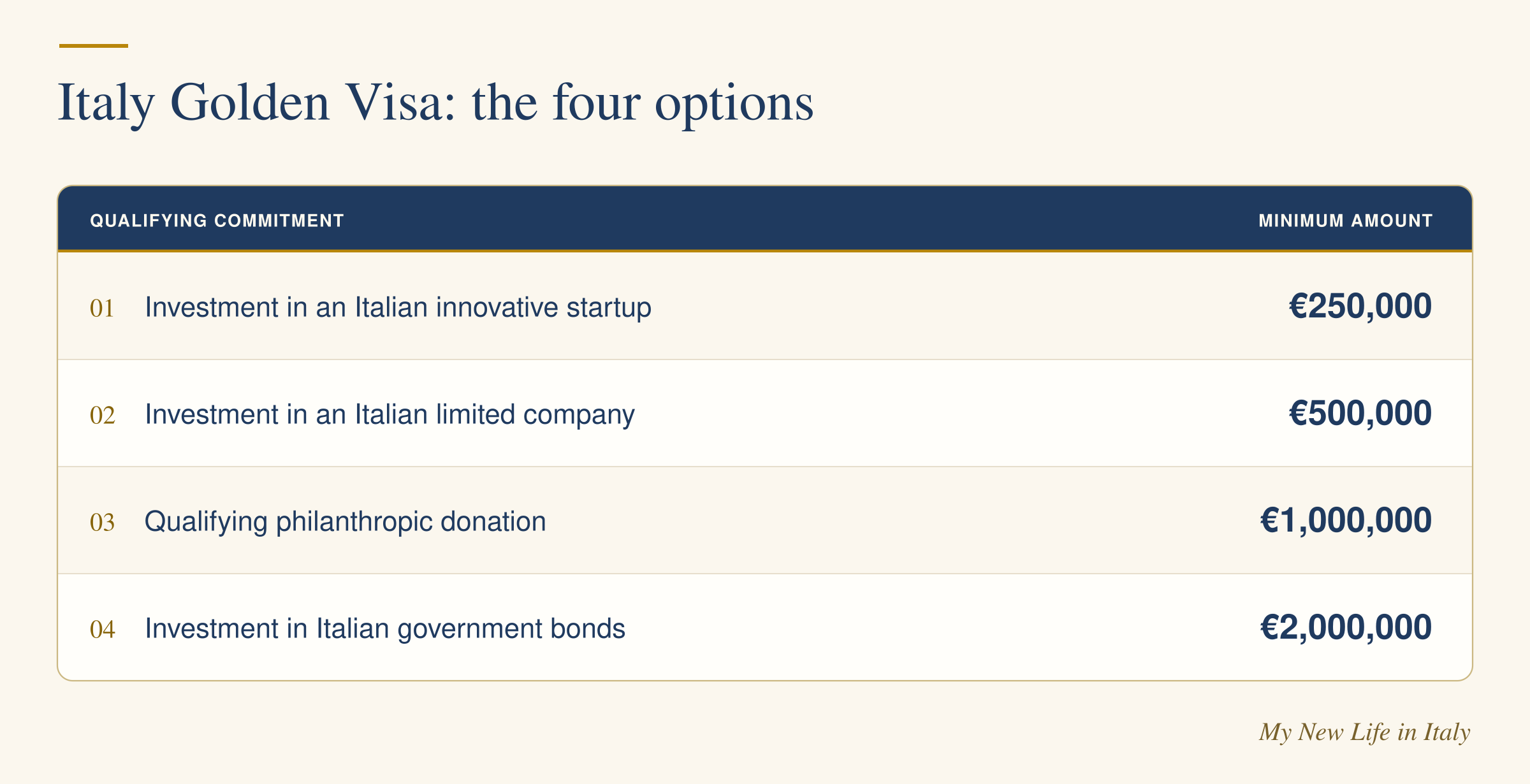
These options have different financial consequences. A donation is not repayable investment capital, and investments carry risk. Check source-of-funds, nationality, authorization, and ongoing requirements before committing. The official programme currently includes restrictions affecting Russian and Belarusian citizens, including certain dual nationals. Official Investor Visa programme.
A house purchase is not one of these qualifying investments.
Employment visa: taking a job in Italy
If you plan to work for an employer in Italy, start with the employer and the relevant work-authorization process.
Many employment entries fall under Italy’s quota system, commonly discussed as the Decreto Flussi. Other categories sit outside those quotas. A job offer alone is not the full immigration process: the employer’s authorization, the visa, and the residence permit each have a role.
Before making commitments, establish which category applies, whether a quota is relevant, and who is responsible for each step. Official employed-worker guidance for Italy.
EU Blue Card: a route for highly qualified employees
The EU Blue Card is a residence route linked to highly qualified employment. Italy’s highly qualified worker route operates outside the ordinary entry quotas. Official Italy guidance.
Eligibility involves the proposed job, appropriate qualifications or recognized experience, and the applicable salary conditions. This is a route to assess with the hiring employer. EU Blue Card eligibility overview.
Do not confuse it with the Digital Nomad route simply because both involve skilled work. Compare the actual job arrangement and application requirements.
Self-employment: independent work and business activity
Italy has a self-employment route for eligible independent activities. Depending on the activity, authorization, financial resources, professional qualifications, registrations, and quota availability can all matter.
Registering a company or opening a VAT number is not, by itself, permission to move to Italy. Work out whether your business or profession fits an available immigration category before paying to establish it. Official self-employed-worker guidance.
If your activity is highly qualified and fully remote, also investigate the Digital Nomad route. Starting a business and investing in a company are different plans and can involve different immigration routes.
Family routes: joining someone in Italy
Check family eligibility early. It may change the route you need to consider.
The procedure depends on whether your family member is an Italian citizen, another EU citizen, or a non-EU resident. Your relationship, the sponsor’s status, supporting documents, and any applicable resource, housing, or residence-duration requirements need to be checked. A relative living in Italy does not automatically qualify every family member to join them.
Family reunification with a non-EU resident · EU residence and family-rights guidance
Assess each person in your household, including a partner who wants to work. Do not assume everyone will follow the main applicant’s exact procedure.
Study visa: moving for a qualifying course
A study route may suit someone undertaking a genuine educational programme in Italy. The course and institution need to support the application; enrolling in any short class does not automatically create a long-stay route.
You may need evidence of admission, funds, accommodation, and health insurance. Study permits allow limited work, generally up to 20 hours per week and 1,040 hours per year. Studies must remain the basis of the stay. Official student guidance for Italy.
Ask the institution about the correct process before paying non-refundable course fees.
Other Italian visa and residence routes
Some situations need a specialist procedure. These are worth identifying even if they are unlikely to fit a retirement plan.
Situation Where to begin
Research with an eligible host institution Researcher route in Italy
A qualifying transfer within a company group Intra-corporate transfer route
Religious activity Official religious-activity guidance
Working holiday or a sporting purpose Consular category directory
Joining US military personnel stationed in Italy Official family-of-military-personnel guidance
Business visits Business-visit requirements
Airport transit Visa types and transit rules
This is an orientation guide, not an exhaustive catalogue of every administrative subcategory. For another purpose of travel, use the Ministry’s entry-visa guidance and official Visa for Italy portal link, then the consulate responsible for your application. Consular examples above do not replace your own jurisdiction’s checklist.
Visiting first: short stays and part-time Italy
You may want to test a town before committing to a move. That can be a sensible planning step, provided you use the correct entry rules.
Whether you need a short-stay visa depends on your nationality and circumstances. The ordinary Schengen short-stay ceiling is 90 days in any rolling 180-day period across the area; a visa may authorize fewer days. A long-validity multiple-entry visa does not mean you can stay continuously for its entire validity. Official visa-duration guidance.
Do not treat permission to visit as permission to move permanently or perform any work you choose.
Use the free Schengen day calculator · Read the guide to living in Italy part-time
After entry: understand the residence permit
A visa and a permesso di soggiorno are different documents. For the usual national-visa process, the Ministry instructs applicants to apply for the residence permit within eight working days after arrival. Follow the procedure for your specific category, including whether submission is through the Questura or another designated channel. Official national-visa instructions.
Build arrival paperwork and renewals into your plan. The visa appointment is one stage of the move.
Common questions about moving to Italy
-
Generally yes, but it's not automatic — switching categories typically means a new application meeting that visa's own requirements, not a simple upgrade. Plan around the visa that fits your situation now rather than assuming an easy path between them.
-
Yes, the e visa allow work for either an Italian based company or a foreign one.
-
No — this is the strictest of the three on this point. The visa requires you to have no employment or self-employment income, foreign or domestic, which is different from the Digital Nomad Visa's foreign-only restriction.
-
Not in the law itself — it requires "ample and stable means," and individual consulates interpret that, which is why real-world figures vary somewhat by where you apply.
-
It's a separate track from things like the 7% flat-tax regime for pensioners — a Golden Visa gets you residency through investment, not a lower tax rate. Some investors do layer it with other tax regimes, but that's a conversation for a tax professional, not a generic answer here.
-
“Retirement visa” is often used as a convenient description of the Elective Residency Visa. Retirement itself is not enough: the route’s financial and other requirements still apply. Someone with citizenship or family rights may have a different route.
-
No. Property purchase is not one of the four qualifying Investor Visa commitments. Sort out your residence route separately from your property search. Official investment options.
-
The useful question is which route you can genuinely document. A category with a lower financial threshold can still be unsuitable for your income, work, family, or intended stay. Start with eligibility, then compare costs and paperwork.
-
Separate appointment waiting time, document preparation, any prior authorization, and the visa decision. Ask your consulate about its current process before making commitments based on a generic online estimate.
-
Possibly, through the route that applies to your household. Check each relative’s eligibility, required documents, timing, and work rights before assuming everyone can move together.
-
Plan immigration and tax together, with separate professional checks. Before choosing a route, have a cross-border tax adviser assess your income, assets, work arrangements, and intended presence in Italy. A visa comparison cannot calculate your tax position.
Turn your shortlist into a practical plan
Once you have a likely route, write down four things: what qualifies you, what evidence you need, what you still need to verify, and which steps must happen before you travel.
For a deeper application walkthrough, explore the Elective Residency Visa Guide or the Complete Italy Golden Visa Guide. You can also browse the available relocation guides.
Still choosing your direction? Start with the free relocation roadmap.
If you are applying from the United States, find the Italian consulate responsible for your state.
This page provides general planning information. Requirements depend on your circumstances and can change. Confirm the current rules with the relevant Italian authority and obtain qualified immigration or tax advice for decisions about your own case.
Still not sure what to do?
If you want answers specific to your situation rather than a general guide, a consultation call is the fastest way to get there.